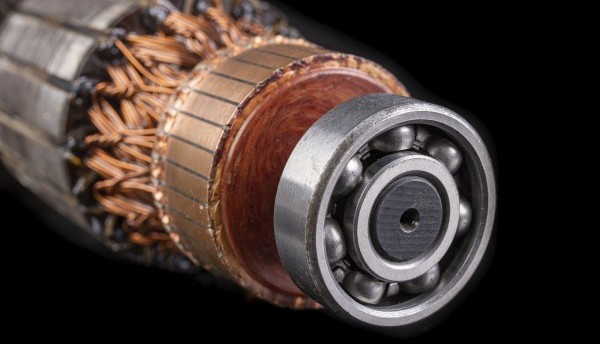
The electric motor market is set for a rapid expansion, driven by the eAxle market and emerging technologies.
Rapid expansion in the electric motor market is on the horizon, driven by the eAxle market and evolving technologies. As original equipment manufacturers increasingly keep design in-house but outsource production, who stands to gain?
S&P Global Mobility forecasts a fourfold increase in the electric motor market in the next 12 years, with an expected production of over 120 million motors by 2034. The eAxle market is set to drive this growth, with its motor production share projected to increase from 38% in 2023 to 69% in 2034.
Emerging technologies like eBeam, akin to the solid beam axle in an internal combustion engine (ICE) vehicle but integrated with an e-motor, are gaining attention. This technology is likely to be driven by the North American pick-up market's loading/towing needs and could potentially grow in the European van market and the pick-up and van markets in Greater China.
Hairpin winding technology is also on the rise due to its efficiency and power density, despite its intricate manufacturing process. It's anticipated to become the preferred choice for eAxle motors, with substantial growth in Europe and North America in the coming years.
While rare earth-based magnet technology currently dominates, exploration of alternatives is underway to lessen this dependence. For instance, employing non-rare earth-based motors in secondary e-Axles, especially for 4WD electric vehicles, could reduce the market share of motors needing Rare Earth Elements from 78% to 60%.
Make vs. buy
OEMs are increasingly relying on in-house manufacturing and continuous research and development to enhance e-motor technologies, reduce costs and improve product development time. This approach provides a safety net for existing factories and jobs, especially in the face of supply chain uncertainties and the gradual discontinuation of ICE vehicles.
While the majority of eAxle system integration is projected to stay in-house until 2030, a new trend is emerging. OEMs are keeping design in-house but are outsourcing the production of motors or their sub-components. This is achieved through strategic sourcing or alliances/joint ventures. This approach is evident in Japan and Korea, with South Asia and Europe likely to adopt this trend by 2035. North America, however, is projected to maintain its focus on in-house sourcing.
Despite OEMs like Tesla and BYD currently leading in-house production, and Volkswagen announcing its in-house development of inverters, outsourcing is forecasted to dominate the global inverter market by 2030 with a 62% market share.
Global investments and key players
The electric motor market has seen global investments, with a boost in North America following the Inflation Reduction Act announcement. From 2023 to 2030, domestic OEMs such as Ford and GM, alongside Asia-Pacific-based suppliers such as Aisin, Hitachi, Hyundai Mobis, and JingJin Electric, are expected to lead the increase in motor production.
In-house production of e-drive components is a major focus for General Motors and Mercedes-Benz, both investing heavily and planning to expand their factory capacities. Similarly, Hyundai and Renault-Nissan-Mitsubishi are shifting more toward in-house e-motor production, reflecting the industry's emphasis on cost optimization and maintaining supply chain resilience.
Dynamic sourcing strategies present opportunities for suppliers
As motor design becomes more of an OEM responsibility and production volumes rise, the potential for outsourcing sub-components grows. This leads to evolving dynamics in the motor supply and presents opportunities for Tier 1 and 2 suppliers, especially in the production of rotors and stators.
With companies like BorgWarner, ZF and Magna already bagging deals to supply e-motor components, and the rise in EV popularity, the production volume of e-motors is set to increase. This growth opens doors for suppliers to expand into the motor subcomponents market, offering opportunities to supply individual rotor and stator components to OEMs.
Michael Southcott, manager, Automotive Propulsion Component Research, Supply Chain & Technology, and lead author of S&P Global Mobility’s E-Motor, Rotor and Stator Component Forecast, says: “Flexibility is just one of the buzzwords around for the traditional Tier suppliers. With OEMs pulling more of the design and assembly in-house, suppliers are having to pivot their business models to maintain production volumes. Recent announcements of large suppliers working with OEMs for just the rotor or just the stator are just the early movements of this. As volumes increase, expect more of this in the active parts of the motor and potentially the inverter also.”