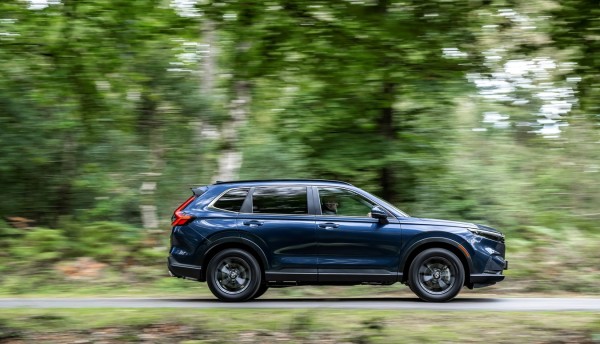
Honda’s CR-V Interior: Thoughtful, not flashy
The interior of the Honda CR-V in its 2026 form reflects incremental change rather than redesign. Honda has retained the structure introduced in 2023 and applied modest updates to technology, equipment and refinement. The result is a cabin that remains competitive on usability and space, but less so on perceived quality and digital sophistication — making it a fitting subject for the next instalment in S&P Global Mobility’s series on in-car technology and materials.
Layout and controls
The dashboard follows a horizontal layout, with a centrally mounted touchscreen and a full-width trim panel that integrates the air vents. This design, shared with the Honda Civic, prioritizes clarity over visual impact.
The aesthetic is deliberately subdued: clean lines, muted finishes and a notable absence of visual clutter. In an era when many manufacturers pursue theatrical interiors dominated by large screens and ambient lighting, Honda’s restraint feels almost contrarian.
Physical controls remain a defining feature. Climate settings are adjusted via rotary dials and buttons, and the steering wheel uses conventional switchgear. Shortcut buttons and a volume knob accompany the infotainment screen.
These tactile interfaces lend a sense of mechanical certainty that touch-based systems often lack. The trade-off is a more conservative appearance, one that risks seeming dated alongside newer rivals.
This contrasts with competitors such as the Volkswagen Tiguan, where more functions are routed through touch-sensitive interfaces. The CR-V’s approach reduces driver distraction but limits the scope for visual customization. It also reflects a broader divergence in industry philosophy: whether to prioritise intuitive operation or digital flexibility. Honda, for now, remains firmly in the former camp.
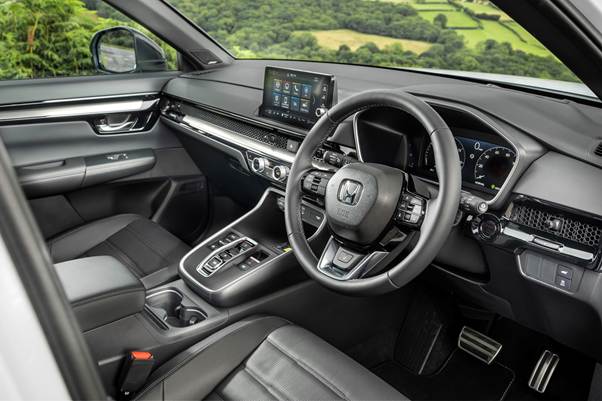
Image source: Honda
Displays and infotainment
A 9-inch touchscreen is standard across the range. The system includes wireless Apple CarPlay and Android Auto, a wireless charging pad, and multiple USB ports, including USB-C connections for rear passengers. This ensures baseline connectivity expectations are met, particularly for younger buyers for whom smartphone integration is non-negotiable rather than optional.
Higher trims receive a 10.2-inch digital instrument display. Lower trims retain a partially digital cluster.
Even in its fully digital form, however, the instrument display favors legibility over flourish. Graphics are crisp but restrained, with limited opportunities for custom layouts or thematic variation.
The infotainment interface is logically arranged and responds adequately to inputs. However, graphics and functionality are relatively basic compared with systems in rivals. The Kia Sportage, for example, offers more advanced displays and greater configurability.
Over-the-air updates capability exists but is not yet leveraged as aggressively as in software-led competitors, leaving the system feeling somewhat static over time. This is increasingly at odds with a market that is beginning to treat in-car software as a living product rather than a fixed specification.
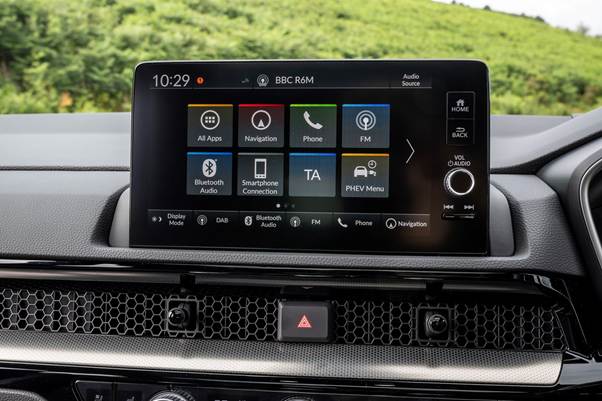
Image source: Honda
Visibility and driving position
The CR-V maintains a high seating position typical of the segment. Electric seat adjustment is standard on most trims, with memory functions available on higher specifications. The driving position emphasizes command and ease rather than sportiness, with a relatively upright posture and clear sightlines in all directions.
Visibility is a relative strength. Large windows, thin front pillars and door-mounted mirrors provide a clear field of view. This simplifies maneuvering and parking, particularly in urban conditions.
In contrast to the rising beltlines and smaller glass areas seen in some competitors, this approach enhances driver confidence, especially for less experienced users.
Compared with the Toyota RAV4, rearward visibility is generally better. Standard parking sensors and a reversing camera assist further; higher trims add a 360-degree camera system.
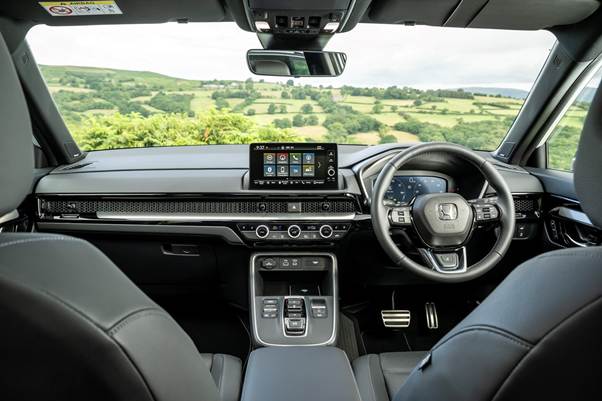
Image source: Honda
Materials and build quality
Material quality is mixed. Upper surfaces are finished in soft-touch materials, and higher trims include leather upholstery and decorative inserts. Build quality is solid, with consistent panel fit.
Lower sections of the cabin use harder plastics. The overall design is restrained, with limited color variation. In this respect, the CR-V is less competitive than more premium alternatives such as the Lexus NX.
The absence of more expressive materials — such as open-pore wood, metal detailing or contrasting textiles — reinforces the sense that longevity has been prioritized over immediate showroom appeal.
For fleet buyers and long-term owners, this may be a rational trade-off; for private customers, it may feel like a missed opportunity.
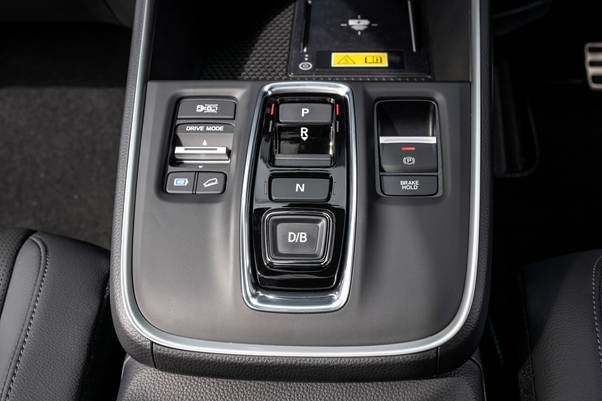
Image source: Honda
Seating and passenger space
Front-seat space is generous, with ample headroom and legroom. Seat comfort is adequate for long journeys, and higher trims add heating and ventilation functions.
Seat cushioning strikes a balance between firmness and support, though it lacks the sculpted bolstering found in more driver-focused alternatives.
Rear-seat accommodation is a key strength. Legroom is among the best in the class, and the flat floor improves usability for three passengers. The rear bench slides and reclines, allowing adjustment between passenger comfort and luggage capacity.
This flexibility highlights the CR-V’s family-oriented design brief, where adaptability often takes precedence over stylistic ambition.
The door apertures and seat height reduce the need for awkward lifting angles, a practical consideration that is rarely emphasized in marketing but widely appreciated in daily use.
A limitation is rear headroom in certain configurations, where roof components reduce available space. This is more noticeable for taller passengers.
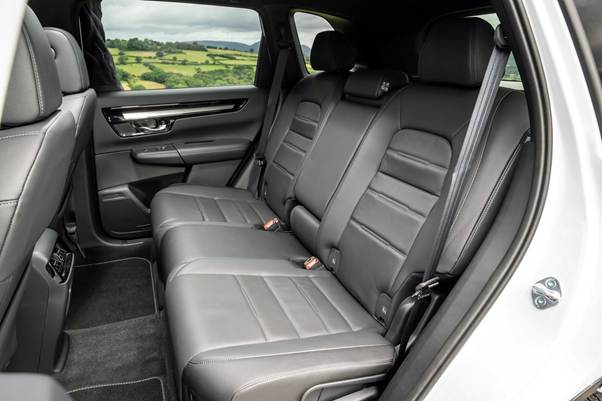
Image source: Honda
Storage and cabin practicality
Interior storage is sufficient but not class-leading. The center console provides a large storage bin and cupholders. Additional compartments are distributed around the cabin, though the glovebox and door bins are relatively small.
Wireless charging placement is convenient, though larger smartphones may fit tightly depending on protective cases.
The layout is practical, but some competitors offer more flexible storage solutions.
Modular storage systems, removable dividers and configurable trays — features increasingly common elsewhere — are largely absent here.
Trunk space and load area
Trunk capacity remains competitive. Hybrid versions offer between approximately 579 and 635 litres, depending on configuration. Earlier petrol models provide about 39 cubic feet of space behind the rear seats.
The transition to electrified powertrains has been managed without a compromise in cargo volume, a notable achievement given packaging constraints.
The load area is wide and accessible, with a low loading lip. An adjustable floor is included in some versions, although it does not create a completely flat surface in all positions. This limits usability when transporting bulkier items, where a continuous load floor would be advantageous.
Rear seats fold in a 60/40 split. This is less flexible than the 40/20/40 configuration available in some rivals, such as the Peugeot 5008.
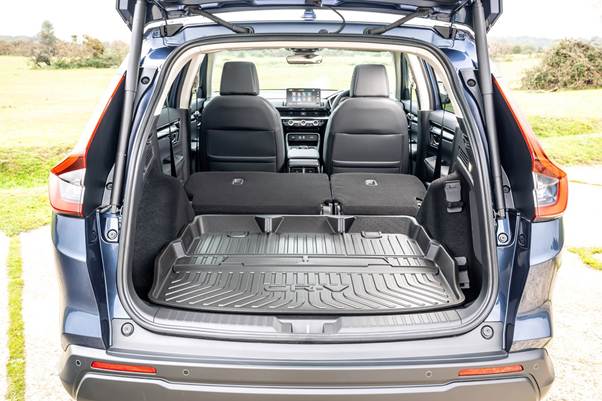
Image source: Honda
Equipment and trim levels
The CR-V is offered in petrol and hybrid variants, with multiple trim levels. Entry-level models include the standard touchscreen, driver-assistance systems and basic comfort features.
Honda Sensing, the brand’s suite of safety technologies, is widely available and integrates functions such as adaptive cruise control and lane-keeping assistance with minimal driver intervention.
Higher trims add a larger digital display, upgraded audio systems, leather upholstery and additional convenience features.
Many features that were previously optional are now standard, particularly in relation to connectivity. This simplifies the range but contributes to a higher starting price relative to some competitors. The resulting specification strategy reduces complexity for buyers but narrows opportunities for lower-cost entry points.
Assessment
The interior of the Honda CR-V is characterized by consistency rather than innovation. Its strengths — space, visibility and ease of use — remain intact in the 2026 model. Updates to infotainment and equipment address some previous shortcomings but do not significantly alter the overall experience.
In this sense, the CR-V exemplifies an evolutionary approach at a time when parts of the industry are pursuing more radical, software-led reinvention.
Weaknesses persist. Material quality is uneven, infotainment systems are relatively basic, and some aspects of flexibility lag behind competitors.
The cabin does not attempt to redefine segment expectations; instead, it consolidates a formula that has proven commercially resilient.
In a segment that includes increasingly differentiated alternatives such as the Mazda CX-50 and Kia Sportage, the CR-V occupies a middle position. It does not lead in any single category, but it avoids major deficiencies.
Such positioning may appear unambitious, yet it aligns with the preferences of a broad customer base that values predictability over novelty.
For buyers prioritizing practicality and ease of use, the interior remains competitive. For those seeking higher perceived quality or more advanced technology, alternatives may offer more.
Ultimately, the CR-V’s interior is less a showcase of innovation than a study in measured iteration —competent, rational and unlikely to surprise.
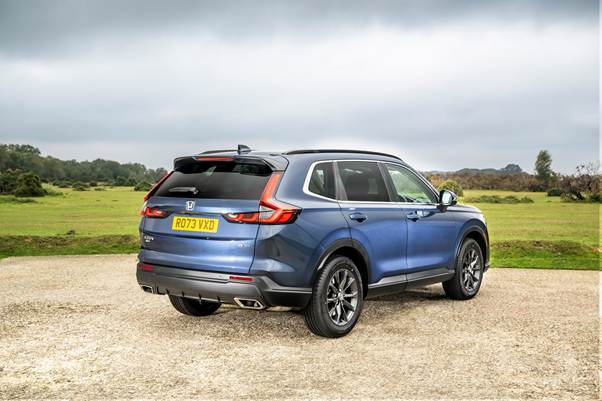
Image source: Honda