Interior Insight: Nissan Micra
24-Jun-2026
For much of the 21st century, Europe’s small car has looked increasingly endangered. Profit margins are meager; regulation is onerous, and consumers — seduced by the commanding ride height of crossovers — have steadily abandoned hatchbacks in favor of bloated alternatives. Yet the electric transition has unexpectedly revived the format. Cars such as Renault’s reborn 5 and Fiat’s electrified 500 have shown that compact vehicles can still stir emotion, provided they blend nostalgia with technology. Nissan’s new Micra EV is the latest entrant into this surprisingly crowded renaissance — and the latest subject in S&P Global Mobility’s continuing exploration of how in-car technology, materials and modern comfort are reshaping the automotive interior.
At first glance, the Micra appears a curious proposition. Nissan once excelled at producing small cars notable mainly for their competence and anonymity. Earlier generations of the Micra sold in vast quantities because they were cheap, dependable and easy to park. Nobody bought one to admire its dashboard. The electric Micra, by contrast, has aspirations beyond mere utility. Built on the same AmpR Small platform as the Renault 5 E-Tech and sharing much of its underlying architecture, it attempts to combine urban practicality with the digital polish expected of a modern electric vehicle.
The result is one of the more intriguing interiors currently available in Europe’s compact-car market: stylish but imperfect, technologically ambitious yet physically constrained.
Screens, buttons and the modern dashboard
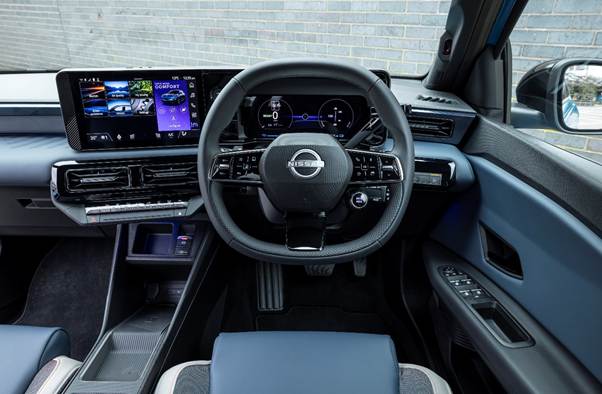
The first impression upon entering the Micra is not of spaciousness but of design intent. Nissan’s cabin designers have clearly decided that small need not mean austere. The dashboard sits relatively low and broad, helping create an airy sensation for front occupants despite the car’s modest dimensions. Two 10.1-inch displays dominate the fascia, arranged horizontally in a manner now obligatory in modern electric cars. Yet unlike many rivals that bury every function within touchscreens, the Micra retains physical climate controls beneath the central display. This sounds banal until one recalls the industrywide epidemic of touch-sensitive sliders and hidden menus that have turned simple tasks into software exercises.
The restraint is welcome. So too is the quality of the infotainment itself. Nissan has leaned heavily upon Google’s automotive ecosystem rather than attempting to reinvent it. Integrated Google Maps navigation, voice control and app support give the system a fluency that many proprietary manufacturer interfaces still lack. In practice, the software behaves less like a traditional car operating system and more like an oversized smartphone mounted elegantly into the dashboard. Younger buyers may take such competence for granted; veterans of laggy automotive software will regard it as near miraculous.
The Micra’s digital environment extends beyond the screens. Smartphone connectivity is seamless, remote pre-conditioning functions are available through Nissan’s app ecosystem and charging information is integrated coherently rather than scattered across submenus. The technological proposition is therefore unusually mature for a small hatchback. Ten years ago, such features were reserved for executive saloons costing several times as much.
Material quality presents a more mixed picture. The upper portions of the cabin’s padded surfaces and textured trims create an unexpectedly premium ambiance. In higher specifications, leather-effect dashboard inserts and ambient lighting lend the Micra a sophistication uncommon in this segment. Certain details appear almost designed to reassure buyers that downsizing need not feel like deprivation.
Yet the illusion weakens lower down. Hard plastics remain plentiful around the center console, lower doors and rear cabin. This is perhaps inevitable. Electric vehicles remain expensive to manufacture, and something has to give. Carmakers increasingly reserve tactile luxury for the surfaces occupants touch most frequently while economizing elsewhere. The Micra follows this formula faithfully. It feels carefully cost-engineered rather than lavish.
The geometry of compromise
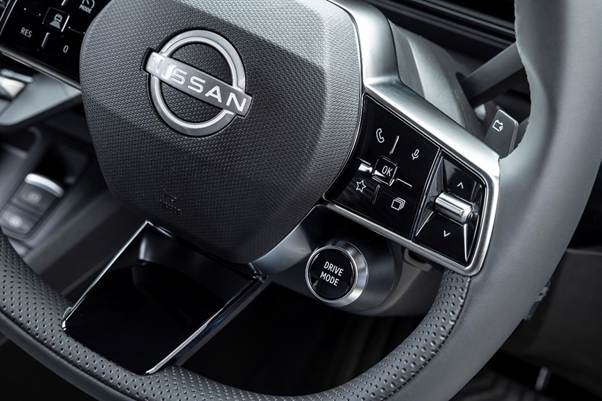
The front seats strike a commendable balance between softness and support, and the driving position is notably accommodating for taller occupants — a characteristic not always found in small electric cars, whose battery packaging can force an awkwardly elevated seating position. Visibility forwards is generally good, though the relatively shallow windscreen and thick roofline create a slightly enclosed sensation.
The true compromise emerges in the rear. Here, the Micra reveals the limits of modern compact EV architecture. Batteries consume valuable floor space, and short wheelbases permit only so much ingenuity. Rear-seat legroom is therefore modest at best and cramped at worst. Adults can fit, but only with negotiation and goodwill. Foot space beneath the front seats is particularly restricted, forcing rear passengers into a knees-up posture reminiscent of economy-class air travel.
This matters because small hatchbacks have historically succeeded by punching above their size. Buyers tolerated modest external dimensions because clever packaging delivered surprising practicality. The original Honda Jazz became famous for this trick; even older Micras possessed a certain Tardis-like efficiency. The electric Micra is less convincing in this respect. It is best understood not as a family car but as an urban commuter occasionally capable of carrying adults in the rear.
Boot space is more encouraging. At roughly 325 liters, the luggage compartment is competitive for the segment and substantially more usable than some fashion-oriented rivals. Folding the rear seats significantly expands capacity, and the load area itself is sensibly shaped. This practicality matters because electric superminis increasingly risk becoming lifestyle accessories rather than genuinely versatile transport.
Nostalgia with Wi-Fi
Aesthetics remain central to the car’s appeal. Nissan’s designers appear acutely aware that Europe’s small-EV market is now driven as much by sentiment as by economics. Buyers choosing between a Micra EV, Renault 5, Mini Cooper Electric or Fiat 500e are not simply comparing battery capacities. They are selecting identities. The Micra, therefore, walks a careful line between retro charm and contemporary minimalism. Certain details reference earlier Micras subtly without descending into caricature. Unlike Fiat’s nostalgic 500, the Nissan does not seem trapped by its own heritage.
This moderation may prove commercially wise. Retro design can age quickly once novelty fades. The Micra instead projects a quieter confidence. Its cabin does not shout for attention. It merely attempts to make daily urban transport feel slightly more dignified.
Whether that is sufficient in Europe’s increasingly ferocious EV market remains uncertain. Chinese manufacturers continue flooding the continent with aggressively priced electric hatchbacks packed with technology. Tesla’s relentless software-centric philosophy has reshaped consumer expectations around digital functionality. Meanwhile, European governments are gradually reducing purchase incentives even as manufacturers face tightening emissions rules. Small electric cars must therefore satisfy contradictory demands: affordable yet profitable, technologically advanced yet simple, fashionable yet practical.
A civilized little machine
The Micra reflects these tensions everywhere. Its infotainment system feels sophisticated, but its rear accommodation reminds occupants of the physical realities imposed by batteries and cost constraints. Its cabin materials flirt with premium aspirations while stopping carefully short of extravagance. It is both ambitious and compromised.
And perhaps that is precisely why the Micra matters. For years, the automotive industry treated small cars as appliances destined either for extinction or relentless cheapening. The electric transition has unexpectedly forced manufacturers to rethink what compact cars should become. If consumers are to pay more for electrified hatchbacks than they once did for petrol equivalents, these vehicles must offer not merely transportation but experience: thoughtful design, digital integration and a sense of occasion.
The Micra largely succeeds on those terms. It is not the roomiest small EV, nor the cheapest, nor the most playful. But it may be among the most coherent. Nissan has produced an interior that understands modern urban priorities surprisingly well. Most journeys consist of one or two occupants navigating congested cities while connected perpetually to digital ecosystems. For such use, the Micra feels intelligent and well-judged.
Still, one suspects the car would have benefited from a few extra centimeters of wheelbase and slightly fewer styling ambitions. Rear passengers might certainly agree. Yet compromises have always defined the small-car segment. The miracle is not that the Micra falls short of perfection, but that a compact electric hatchback now offers this level of sophistication at all.
The small car, it seems, is not dead. It has simply become more complicated.