


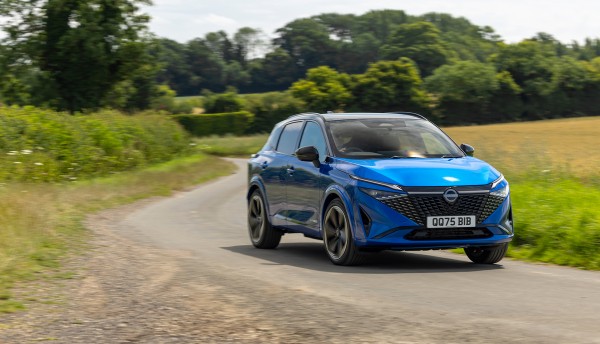
The family car was once a blunt instrument. It needed to seat five, swallow a pram and survive supermarket car parks. Style was optional; charm was rare. Yet over the past decade, the family crossover has become the automotive industry’s central product: a machine expected not merely to transport but also to reassure, entertain and flatter. Few vehicles in Europe embody that evolution more fully than the Nissan Qashqai, whose latest interior reflects a broader transformation in automotive design — one that this series from S&P Global Mobility continues to explore through the lens of in-car technology, materials and modern comfort.
[Image source: Nissan]
The sensible sanctuary
When Nissan launched the original Qashqai in 2007, it was regarded as a curious compromise — a hatchback inflated into something vaguely resembling a sport utility vehicle (SUV). Rivals scoffed, before hurriedly copying it. Nearly two decades later, the Qashqai sits in the middle of one of the continent’s most crowded markets, competing against the Kia Sportage, Hyundai Tucson, Peugeot 3008 and Volkswagen Tiguan. Horsepower matters less here than ambience; buyers judge not only ride quality and fuel economy, but also cupholders, touchscreen logic and whether rear passengers can charge their phones without diplomatic intervention.
The latest Qashqai facelift, introduced across Europe in 2025, reflects motorists’ changing priorities. Mechanically, little has changed, but inside the cabin, Nissan has quietly rewritten the car’s character. The modern family crossover is no longer designed around driving alone; it is designed around inhabiting.
Order without ostentation
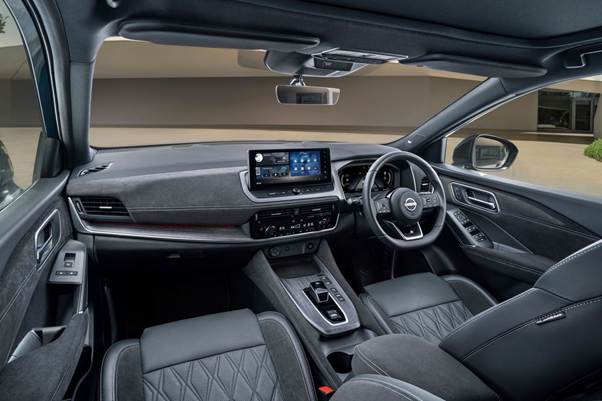
The first impression is one of restraint. Many rivals, particularly from China, now resemble mobile consumer-electronics exhibitions, all flashing LEDs and layered touchscreens. Nissan has resisted this temptation, keeping the Qashqai’s interior conservative and almost architectural in layout. Physical buttons survive for climate controls, and the dashboard is horizontal and uncluttered. Visibility remains excellent, aided by relatively slim pillars and a seating position that lifts occupants just enough to create the illusion of command without requiring mountaineering equipment to climb aboard. Such sanity has become oddly luxurious.
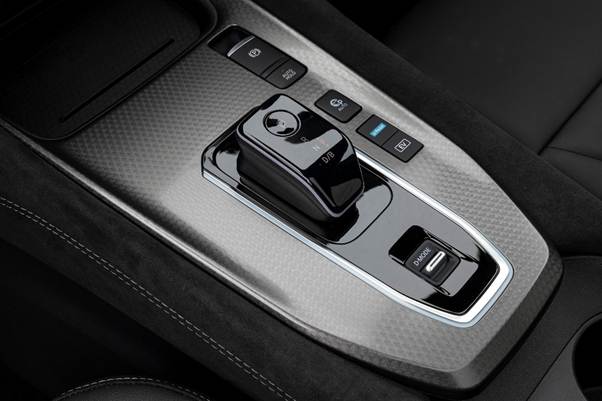
Material quality has improved noticeably in the updated model. Soft-touch surfaces spread across the upper dashboard and door tops, while higher trims receive quilted leather upholstery and Alcantara inserts intended to lend a faintly Scandinavian atmosphere. Some cheaper plastics remain lower down the cabin, especially around the center console and transmission tunnel, but the overall impression is of solidity rather than spectacle.
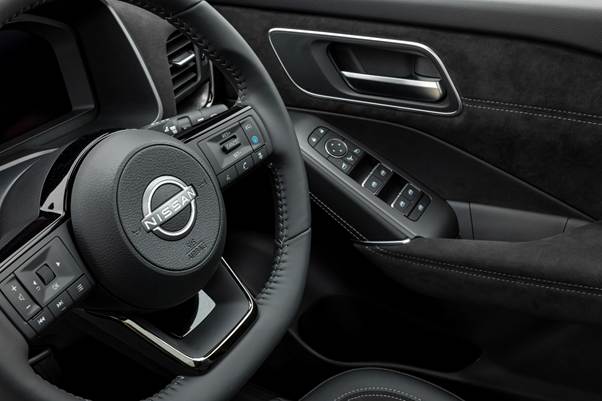
This matters because the Qashqai occupies a difficult middle ground; neither expensive enough to compete as a premium product, nor cheap enough to excuse obvious compromises. Nissan’s answer has been to make the cabin feel mature: the switches move with reassuring weight, the steering wheel is pleasantly thick-rimmed, and ambient lighting is subtle rather than nightclub-inspired. Even the seats reveal careful calibration between softness and support.
[Image source: Nissan]
The politics of passenger comfort
The front seats deserve particular praise. Contemporary crossovers often confuse firmness with sportiness, producing pews better suited to punishment than transport. Nissan instead prioritizes long-distance comfort. The cushions are broad, visibility is commanding and entry is easy without forcing occupants into the upright posture of a kitchen chair. Heated and massaging seats are available on upper trims, although the real achievement lies in ergonomics rather than gadgetry.
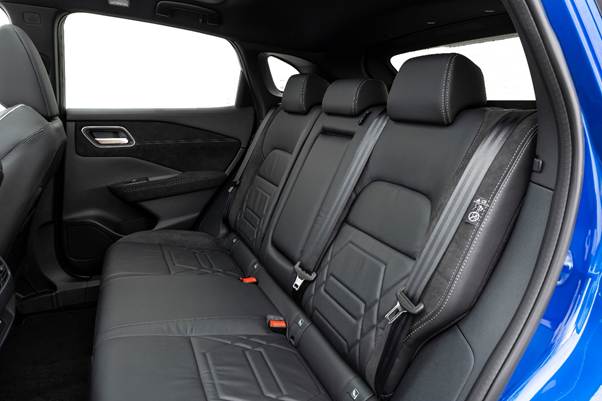
The rear seats tell a more complicated story. Legroom is generous enough for average adults, and the flat floor improves middle-seat usability compared with many rivals. The rear doors open wide, easing the installation of child seats — a key but often neglected metric in family motoring. Yet the Qashqai is not cavernous; three adults across the rear bench remain feasible chiefly for short journeys or unusually harmonious families.
[Image source: Nissan]
Still, Nissan understands the sociology of modern parenting. There are USB-C charging ports in the rear, door bins large enough for water bottles and enough headroom to prevent complaints from adolescents who have recently discovered posture. Small details matter in family cars, because family life itself is largely composed of small inconveniences.
Storage provision throughout the cabin is similarly thoughtful. The center console houses a large cubby beneath the armrest, while the redesigned wireless charging pad finally grips smartphones securely. Cupholders are sensibly sized; the glovebox remains large enough for manuals nobody reads and receipts nobody throws away.
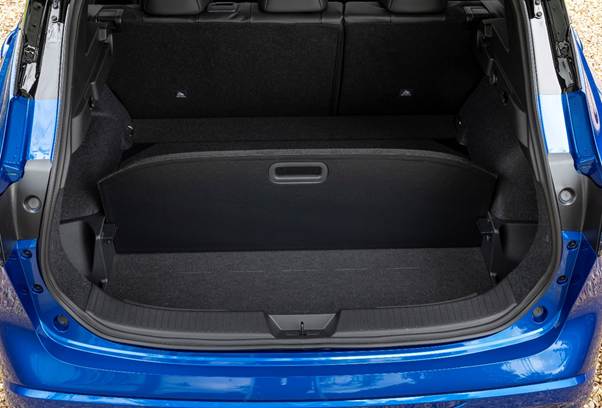
Boot space, at just over 500 liters in most configurations, is competitive without leading the class. More importantly, the shape is usable; with a low load lip, relatively square floor and an adjustable boot floor that helps divide shopping from dirtier cargo. The rear seats fold nearly flat, creating enough space for bicycles, flat-pack furniture or accumulated detritus.
[Image source: Nissan]
Silicon Valley meets Sunderland
Practicality, however, no longer defines the modern family crossover on its own. Increasingly, these vehicles are judged by software.
Here the Qashqai illustrates both the promise and anxiety of the contemporary car industry. Nissan’s updated infotainment system now incorporates Google Built-in technology, integrating Google Maps, Assistant and app functionality directly into the vehicle. In practice, this means navigation works properly — a surprisingly rare achievement among carmakers. Voice recognition is fast and accurate, traffic rerouting is intelligent, and directions appear not only on the central touchscreen but also within the digital instrument cluster and optional head-up display.
This integration reflects a broader shift occurring across the industry, as carmakers increasingly concede that Silicon Valley firms understand software better than automotive engineers do. Consumers, meanwhile, expect their cars to behave like smartphones: instantly responsive, endlessly connected and quietly updated in the background.
Yet this dependence creates vulnerabilities. Owner forums reveal recurring complaints about connectivity glitches, profile synchronization problems and intermittent failures within Nissan’s companion app. Such issues are rarely catastrophic, but they expose the awkward reality of the software-defined car. Mechanical unreliability once meant broken pistons or faulty gearboxes; today, it may mean a navigation system refusing to recognize a driver’s account.
The irony is that the Qashqai’s greatest strength lies precisely in avoiding excessive digital abstraction. Unlike some of its rivals, Nissan has retained physical controls for key functions. Temperature adjustments require neither submenus nor meditative concentration, and drivers can alter volume without sliding fingers across glossy black panels that immediately collect fingerprints. In an era where many manufacturers appear to design interiors primarily for technology demonstrations, Nissan remembers that motorists often wish simply to operate the car.
A quieter kind of luxury
The cabin’s refinement reinforces this philosophy. Road and wind noise are well suppressed, particularly at motorway speeds. The e-Power hybrid variant — effectively an electric drivetrain powered by a gasoline engine acting as a generator — further enhances the impression of calmness around town. At low speeds, the Qashqai frequently feels more electric than hybrid, gliding quietly through traffic while insulating occupants from mechanical commotion.
This serenity is not accidental; family cars today increasingly function as extensions of domestic space. Parents conduct conversations, children watch screens, commuters consume podcasts and conference calls migrate from offices into traffic jams. The crossover cabin has become a semi-private living room traveling at 70 mph.
Manufacturers therefore compete not merely on engineering, but also on cognitive load. Which car is least tiring to inhabit? Which asks the fewest questions of its occupants? Which creates the strongest illusion that modern life remains manageable?
The Qashqai performs strongly because it rarely tries too hard. It does not overwhelm occupants with avant-garde design or technological theatre, prioritizing coherence instead. Every major control sits where one expects, and the infotainment system is modern without becoming domineering. It has comfortable seats, plentiful storage, and durable-feeling materials. Nothing dazzles individually, but everything functions collectively.
[Image source: Nissan]
Calm as a competitive advantage
The average family crossover spends much of its existence performing mundane tasks under stressful conditions: school runs, motorway traffic, supermarket expeditions, airport pickups. Excellence in this category is measured not through excitement, but through the minimization of friction.
The Qashqai’s interior succeeds because it recognizes this reality; acknowledging that drivers increasingly value calmness over novelty and usability over experimentation. The car industry spent much of the past decade pursuing digital futurism, often mistaking complexity for progress. Nissan’s cabin instead suggests a gentler conclusion: that genuine sophistication lies in making complicated things feel simple.
For now, at least, the family crossover remains Europe’s default domestic appliance on wheels. Electrification, Chinese competition and changing urban policies may yet reshape the market, but the essential challenge will endure. Millions of motorists still require a vehicle capable of transporting children, luggage and accumulated anxieties with minimal complaint.
The Nissan Qashqai may not be the most glamorous answer to that problem — it may not even be the best. Yet its interior demonstrates why the model continues to matter. It understands that modern comfort is not about excess, but rather, about reducing the number of things demanding one’s attention.
In the age of permanent distraction, that is a form of luxury.


