Filters
Your Selections
    Asset
    Published
    Vehicle Domain
    Topical Categories
    Application Area
    From ‘eyes-off’ hype to ‘hands-free’ reality: Premium OEMs bet big on L2+
    While automakers from China to North America have publicly confirmed their intentions to pursue Level 3, others most notably the early adopter German premiums are subtly easing off their Level 3 ambitions as their latest Level 2+ systems come to market. BMW, Mercedes‑Benz and Stellantis all went to market with highly publicized Level 3 plans, and both German automakers have Level 3 systems in market today in very limited availability. But each has discovered that the combination of high cos...
    BEV-native leadership and established OEM transition in SDV readiness
    The recent adoption by many original equipment manufacturers (OEMs) of an electrical/electronic (E/E) architecture based on zone controllers supporting a software-defined vehicle (SDV) is slowly replacing distributed electronic control architectures that rely on small pieces of control code housed and distributed widely inside isolated electronic control units (ECUs). This new approach centralizes the hardware processing and memory in fewer, more powerful control units that will house functional...
    From analog dominance to the memory era: How vehicle architecture and memory pricing are reordering automotive semiconductor demand
    S&P Global Mobility expects the automotive semiconductor market to return to growth in 2025, expanding by 6.6% to surpass $90 billion following a flat 2024. Looking further ahead, revenue is forecast to rise at a 7.4% compound annual rate through 2031, approaching $140 billion by the end of the period. The expansion is driven by the accelerating shift toward software-defined vehicles, higher levels of autonomy, electrified powertrains and increasingly sophisticated cockpit platforms, all of ...
    OPmobility eyes Hyundai Mobis lighting business to accelerate global expansion
    In late January, OPmobility signed a memorandum of understanding (MOU) with Hyundai Mobis to explore the potential acquisition of the South Korean supplier’s lighting business. The two companies aim to reach a definitive agreement in 2026. The acquisition promises to significantly expand OPmobility’s global position as one of the leading tier 1 suppliers of lighting systems, a business the French supplier entered just four years ago. Hyundai Mobis is the largest tier 1 ...
    Navigating the software-defined vehicle landscape with BMW, Valeo Brain and KPIT
    This analysis summarizes insights from an Autology podcast featuring Joachim Mathes, CTO of Valeo Brain; Venkatraman V, senior practice director at KPIT; and Christoph Grote, senior vice president of Electronics and Software at BMW Group, hosted by Jeremie Bouchaud, director of Autonomy, E/E & Semiconductor, SDV at S&P Global Mobility. The discussion focuses on the transformative potential of SDVs in the automotive industry, emphasizing the integration of sophisticated software capabilit...
    A new tug of war for semiconductors: data centers vs. automakers
    The automotive semiconductor market has been navigating a period of unusual volatility. On one side, near-term demand pressures are easing. The slowdown in electric vehicle adoption is reducing average chip content per vehicle, since EVs typically contain significantly more semiconductors than internal combustion models. Tariffs are further dampening global vehicle demand. S&P Global Mobility estimates suggest up to 0.6 million fewer vehicles will be produced in 2026 because of trade barrier...
    Autonomous mobility in Europe and the Middle East: The next battleground for robo-taxis and robo-buses
    As autonomous driving gains renewed global momentum, a strategic window is opening in Europe and the Middle East where mainland Chinese tech giants are moving early while US leaders like Tesla and Waymo remain focused on North America. Companies such as Baidu, WeRide and Pony.ai are rapidly launching pilot programs and forming local partnerships to capture first-mover advantages in these emerging markets. Domestic momentum: Commercialization of autonomous driving in mainland China and the US ...
    The green shift: Insights from Harman Automotive on sustainable practices
    The automotive industry is undergoing a significant shift toward sustainability, largely fueled by increasing consumer awareness of environmental issues. Today’s consumers are more concerned than ever about the ecological impact of their purchases, which has created a strong demand for sustainable practices throughout the automotive supply chain. As a result, suppliers are under pressure to integrate eco-friendly initiatives at every stage, from sourcing materials to manufacturing processes, t...
    Is BYD’s new platform the technological inflection point EVs need?
    The adoption of electric vehicles has not progressed as smoothly as anticipated five years ago. Many have questioned whether the transition to EVs is beneficial, as concerns about their practicality in everyday use persist, despite the advantage of zero tailpipe emissions. According to the S&P Global Mobility consumer survey conducted in 2024, primary concerns include the availability of charging stations, long charging times and the range on a single charge. Nearly half of the respondent...
    How software-defined vehicles are shifting gears: Insights from Valeo Brain's CTO
    The emergence of software-defined vehicles (SDVs) is transforming the automotive industry by integrating advanced technologies, enhancing connectivity, and redefining the relationships between original equipment manufacturers and suppliers. SDVs leverage software to provide enhanced driving automation and improved user experiences, facilitated by advanced driver assistance systems and innovative vehicle interiors. The increasing reliance on data sharing between OEMs and suppliers is paramount, a...
    Navigating change: How automotive suppliers are adapting to consumer demands
    The automotive industry is rapidly evolving, shaped by shifting consumer preferences and economic pressures. Suppliers must be agile and proactive, swiftly responding to consumer demands while balancing production costs and profitability in a fiercely competitive market. The S&P Global Mobility 2025 Supplier Outlook emphasizes the need for suppliers to tackle these market changes head-on. Consumer behavior in flux Economic factors are key in shaping how consumers behave. In turn, these...
    Q&A with Harman on future-proofing connected vehicles
    According to S&P Global Mobility, the average age of cars and light trucks in the United States is now 12.6 years, and software obsolescence is a pressing challenge for Original Equipment Manufacturers. To stay competitive in the software-defined vehicle landscape, OEMs must ensure their vehicles are future-proof; this means designing telematics control units (TCUs) that easily upgrade from 4G to 5G and incorporate satellite communications for high-bandwidth, low-latency connections. Over...
    The impact of semiconductor tariffs on automotive costs: A quantitative analysis
    Amid escalating trade tensions, US President Donald Trump has intensified pressure on key industries with a series of executive orders, ordering a review of US trade agreements and signaling further tariffs on automotive, semiconductors and pharmaceuticals. With a potential 25% tariff on all imported vehicles and new steel and aluminum tariffs set to take effect on March 12, 2025, the automotive sector faces mounting uncertainty. With the rise of software-defined cars, semiconductor content p...
    Tesla's Cybercab: Self-driving dream or a detour to disappointment
    The journey of autonomous vehicles began long before the unveiling of Tesla's Cybercab in October 2024. The concept of self-driving cars dates to the early 20th century, with experimental models emerging in the 1920s. Carnegie Mellon University developed the Navlab project in the 1980s, thus making the first significant strides in automation. The DARPA Grand Challenge of 2004 and 2005, plus the DARPA Urban Challenge of 2007 highlighted the potential of autonomous vehicles, igniting interest from...
    Pioneering the road ahead: key automotive innovations unveiled at CES 2025
    Over the years the Consumer Electronics Show (CES) has become a center stage for automotive innovations. CES 2025 focused on the practical implementation of existing technologies rather than introducing new concept models, highlighting a shift toward refining and deploying previously unveiled innovations. Software-defined vehicles (SDVs) emerged as a central theme at CES 2025, reflecting their growing prominence and the intensified support from the broader automotive ecosystem. However, particip...
    Chips and challenges: TSMC's export restrictions and its fallout for mainland China's auto industry
    The recent directive from the US Commerce Department to Taiwan Semiconductor Manufacturing Co. (TSMC) requires the company to halt shipments of advanced chips used for AI applications to mainland Chinese companies. Effective Nov. 11, 2024, this order targets chips of 7 nanometers (nm) and below, which are essential for supporting AI workloads and graphics processing units (GPUs). TSMC's decision to restrict the use of 7 nm or below processes for AI companies reflects its strategic positioning...
    Generative AI: A catalyst for autonomous driving amid validation challenges
    During the first half of 2024, automakers have notably advanced the integration of generative AI across multiple segments, such as infotainment systems, vehicle personalization and in-car personal assistants. This integration has enhanced the user experience by providing personalized content, real-time navigation, and intelligent voice interactions, transforming vehicles into more intuitive and adaptive environments. Generative AI is also poised to redefine autonomous driving by enabling systems...
    Automotive Supplier Outlook 2025: Volume 2 Companies E - I
    S&P Global Mobility’s Matthew Beecham has engaged senior executives from 42 suppliers in the automotive supply chain for an end-of-year interview initiative. This initiative seeks to gather valuable insights into the challenges faced in 2024 and the strategies being formulated for 2025, prioritizing genuine experiences over elaborate strategies. This report is the second of four volumes. The key discussion points include ongoing supply chain disruptions, labor shortages, and regulatory ...
    Talking Heads: Disconnected vehicles
    The US Commerce Department issued a notice of proposed rulemaking (NPRM) on Monday (Sept. 23) which, if approved, would ban the sale or import of vehicles that incorporate connectivity technologies plus systems incorporating prohibited hardware and software from countries of concern, specifically mainland China and Russia. The NPRM follows a process initiated by President Joe Biden in February and is based on public feedback to an earlier notice issued by the Commerce Department, which sought to...

    Hurricane Helene: Implications for the semiconductor supply chain
    In late September, Hurricane Helene caused significant damage across the southern US. The storm brought heavy rainfall, widespread power outages and forced many residents to evacuate. The damage will impact individuals, families, communities and entire regions for weeks, months and perhaps years. Spruce Pine, NC, a small town vital to the global semiconductor supply chain, was among the hardest hit. It is home to the largest known deposit of high-purity quartz (HPQ), supplying over 70% of the wo...


    Future of imaging radar: Interview with Aptiv
    Four-dimensional (4D) imaging radar is a key technology for autonomous driving, providing real-time and accurate information about the surrounding environment. To learn more, we spoke to executives from Aptiv. Four-dimensional imaging radar is an emerging key technology for autonomous driving, providing real time and accurate insights into the surrounding environment. It complements other sensors such as cameras and is used in conjunction with these in the automotive industry. The 4D imaging ...
    Volvo's software hurdles: Is software the new Achilles' heel of legacy automakers?
    In June, Volvo recalled the EX30 electric small sport utility vehicles (SUVs) owing to a software issue. The software update, intended to enhance features and functionality, instead led to a multitude of problems and a surge in customer returns and refund demands. This situation has resulted in a range of issues, including blacked-out infotainment screens, incorrect information displayed on functioning screens and driver profiles reverting back to factory settings. Furthermore, driver aids have ...
    Radar reimagined – Interview with Magna International
    Four-dimensional imaging radar is a crucial technology for autonomous driving, providing real-time and accurate information about the surrounding environment. To learn more, we spoke to Jeff Liscouski, director, Product Management Radar at Magna International and Christian Frank, director, Pre-Development Radar at Magna International. A key technology for autonomous driving, 4D imaging radar complements other sensors such as cameras and is used in conjunction with them in the automotive indus...
    Suppliers to the Dodge Charger
    The Dodge Chargers will be built in Windsor, Ontario. Production of the car is expected to peak at 31714 in 2025, according to a forecast from S&P Global Mobility Image Source : Dodge  Suppliers to the Dodge Charger COMPONENT NAME SUPPLIERS Low Voltage Battery Clarios Panel Retainers - Air Induction System EFC International Seat Cross Member , A-Pillar ,  Gestamp Roller Finger Follower...
    Suppliers to the Renault Symbioz
    The Renault's new compact C-Segment SUV, the Symbioz is manufactured at the Valladolid plant in Spain. Production of the car is expected to peak at 75345 in 2025, according to a forecast from S&P Global Mobility Image Source : Renault  Suppliers to the Renault Symbioz COMPONENT NAME SUPPLIERS HVAC Module Denso Electronic Park Brake Switch Kostal Cylinder head Nemak Center Console, Inst...
    Navigating compliance costs: OEMs' dilemma in making legacy vehicles compliant with cybersecurity
    The implementation of the United Nations Economic Commission for Europe (UNECE) R155 cybersecurity regulation has ramifications for the automotive industry that are more immediate than one would ordinarily expect in the vehicle planning process. It has led to some shuffling of vehicle portfolios among original equipment manufacturers due to inputting cost-benefit scenarios into the vehicle planning process. Porsche's decision to discontinue sales of the internal combustion engine (ICE)-powered M...
    Soft landing for automotive semiconductor industry in 2024
    The automotive semiconductor market grew another 18% in 2023 based on revenue share analysis. A solid performance, but 6 points lower than the previous forecast. What happened? What does it mean for the 2024 outlook and beyond? 2023 was good, but not as good as expected The automotive semiconductor market experienced a more than 25% increase in revenue in both 2021 and 2022, demonstrating significant momentum. Subsequently, in 2023, the market continued its upward trajectory with an increa...
    Seeing the unseen: The power of 4D imaging radar
    Four-dimensional imaging radar is an emerging key technology for autonomous driving, providing real time and accurate insights into the surrounding environment. It complements other sensors such as cameras and is used in conjunction with these in the automotive industry. The 4D imaging radar uses multiple antenna arrays to gather extensive data and generate precise 3D models. It operates at frequencies such as 77 or 79 GHz, enabling split-second reaction times that are required for autonomous ve...
    Suppliers to the Mercedes Benz G-class
    The Mercedes Benz G-class is produced at the Magna Steyr plant in Graz, Austria. Production of the car is expected to peak at 33521 in 2025, according to a forecast from S&P Global Mobility. Image Source : Mercedes-Benz  Suppliers to the Mercedes Benz G-class COMPONENT NAME SUPPLIERS Coupling Flange Hirschvogel Automotive Group Floor Carpet Auria Steering Wheel Switch Kostal Low-voltage battery ...
    Exploring the future of vehicle network architectures: highlights from the Automotive Ethernet Congress
    The Automotive Ethernet Congress is a high-profile event that brings together leading technology experts to discuss the future direction of new vehicle network architectures and all-automotive Ethernet network communication. This congress, typically held annually, focuses on current and future technology and product developments in the automotive Ethernet industry. The event provides a platform for professionals to share knowledge and insights on advanced features of automotive Ethernet technolo...
    Suppliers to new BMW 5-Series
    The BMW 5-series is produced at the company’s Dingolfing plant in Germany . Production of the car is expected to peak at 37949 in 2024, according to a forecast from S&P Global Mobility. Image Source : BMW (ICE version shown)  Suppliers to  BMW 5-Series COMPONENT NAME SUPPLIERS Prop Shaft Hirschvogel Automotive Group Floor Carpet Auria HVAC Module Denso Low-voltage battery Clarios ...
    Nvidia GTC 2024: Accelerating automotive innovation through AI
    Nvidia’s GPU Technology Conference (GTC) 2024 took place March 18–21, 2024, at the San Jose Convention Center in San Jose, California. GTC serves as a platform for developers, researchers, engineers, and innovators to explore the latest advancements in GPU technology and its applications across various industries such as AI, autonomous vehicles and more. The conference featured keynote presentations, technical sessions, hands-on workshops and demonstrations all aimed at fostering collabor...
    Talking Heads: Apple shifts gears
    After a decade of unannounced efforts, Apple has reportedly abandoned Project Titan, its ambitious plan to develop electric vehicles. Initially, the project aimed to create an EV to rival Tesla, later shifting focus toward a self-driving car to compete with Google's Waymo. However, it eventually returned to its original focus: An EV with driving-assistance features. As a result, some of its 2,000 employees will transition to Apple's AI division, though layoffs are expected.  In the lates...
    The shift to software-defined vehicles: Q&A with Harman
    Software-defined vehicles (SDVs) use software to govern operations, incorporate new features, and facilitate the integration of novel functionalities. This concept marks an advancement in the automotive industry, laying the foundation for autonomous driving and vehicle connectivity technologies. The evolution of SDVs entails separating software and hardware development, like smartphones. OEMs are establishing “walled gardens” for applications. This shift encompasses continuous agile softw...
    Automotive Supplier Outlook 2024
    The automotive industry grappled with a range of challenges this year, including ongoing supply chain disruptions, chip shortages, rising energy costs, inflation, recession fears, waning consumer demand, a shift towards software and electronics, labor shortages, strike action, and volatile order forecasts. It also faced several geopolitical concerns and challenges, including the ongoing trade tensions between the US and China, which resulted in tariffs and trade barriers that disrupted global su...
    Talking Heads: Key themes for 2024
    As we approach the end of 2023, our “Talking Heads” series delves into conversations with the practice leads at AutoTechInsight. The aim is to explore the challenges and opportunities that lie ahead in their respective domains. The automotive industry faces challenges and opportunities shaped by the pandemic and technological advancements. Electrification is a key factor impacting new car prices, especially in Europe. A potential price war among EVs in mainland China is a concern. Afforda...
    INTERVIEW: Infineon Technologies on electric/electronic architecture migration
    The software-defined vehicle architecture is poised to bring about a transformative shift in the automotive industry by facilitating a flexible and adaptable solution for the assimilation of cutting-edge technologies, features and services such as charging infrastructure, predictive maintenance, autonomous driving, connected vehicles, enhanced safety systems, as well as financial technology and blockchain. This necessitates a comprehensive reimagining of the vehicle's electric/electronic (E/E) a...
    Chiplets: Tiny building blocks can make a big difference
    The automotive industry is currently experiencing profound shifts, ranging from electrification to the introduction of innovative vehicle features. Central to these transformations is the escalating importance of semiconductors. Traditional computing capacities housed in electronic control units (ECU) based on microcontroller units (MCUs) are rapidly becoming inadequate in the face of the expanding computational demands brought on by advanced driver-assistance systems (ADAS), communication proto...
    INTERVIEW: Ambarella on electric/electronic architecture migration
    The software-defined vehicle architecture is poised to bring about a transformative shift in the automotive industry by facilitating a flexible and adaptable solution for the assimilation of cutting-edge technologies, features and services such as charging infrastructure, predictive maintenance, autonomous driving (AD), connected vehicle, enhanced safety systems, as well as financial technology and blockchain. This necessitates a comprehensive reimagining of the vehicle's electric/electronic (E/...
    INTERVIEW: Mobileye on electric/electronic architecture migration
    The software-defined vehicle architecture is poised to bring about a transformative shift in the automotive industry by facilitating a flexible and adaptable solution for the assimilation of cutting-edge technologies, features and services such as charging infrastructure, predictive maintenance, autonomous driving, connected vehicle, enhanced safety systems, as well as financial technology and blockchain. This necessitates a comprehensive reimagining of the vehicle electric/electronic (E/E) arch...
    Looming semiconductor talent shortfall indicates a tangled road ahead
    Semiconductor exhibitions recently witnessed a resurgence in participation, with attendee and sponsor numbers surpassing pre-pandemic levels. The TSMC Symposium and SEMICON West are two such notable events that concluded a few months ago revealing several clear industry trajectories. Paramount among these is the automotive sector's emergent dominance within the semiconductor landscape. It is no longer just about in-car entertainment; we are witnessing a seismic shift as vehicles evolve into tech...
    Tier 1 suppliers on electric and electronic architecture migration
    The software-defined vehicle (SDV) architecture is poised to bring about a transformative shift in the automotive industry by facilitating a flexible and adaptable solution for the assimilation of cutting-edge technologies, features and services, such as charging infrastructure, predictive maintenance, autonomous driving, connected vehicle, enhanced safety systems, as well as financial technology and blockchain. This necessitates a comprehensive reimagining of the vehicle E/E architecture, espec...
    INTERVIEW: Aptiv on electric/electronic (E/E) architecture migration
    The software-defined vehicle architecture is poised to bring about a transformative shift in the automotive industry by facilitating a flexible and adaptable solution for the assimilation of cutting-edge technologies, features and services, including charging infrastructure, predictive maintenance, autonomous driving, connected vehicles, enhanced safety systems, as well as fintech and blockchain. This necessitates a comprehensive reimagining of the vehicle E/E architecture, especially the softwa...
    ROUND TABLE: How AI is reshaping engineering in the automotive industry
    AI can address specific original equipment manufacturer challenges, enabling greater product development efficiency and faster time to market, which are crucial in the highly competitive automotive industry. Marking the first of our series of roundtable discussions with automotive industry specialists, we gathered three experts to learn more about the current and potential use of AI in the automotive industry, covering sales efficiency, potential job creation, regulatory aspects and its role in ...
    NXP Connects 2023: A glimpse into next-gen automotive semiconductor innovations
    NXP Connects is an annual conference organized by tier-1 semiconductor supplier NXP Semiconductors. The conference brings together industry professionals, engineers, designers and technology enthusiasts to explore the latest advancements in the world of semiconductors, embedded systems, and internet of things (IoT) technologies. NXP Connects provided a platform for attendees to gain insights into NXP's cutting-edge products, solutions and technologies. The conference featured keynote presenta...
    INTERVIEW: ECARX on electric/electronic (E/E) architecture migration
    The software-defined vehicle architecture is poised to bring about a transformative shift in the automotive industry by facilitating a flexible and adaptable solution for the assimilation of cutting-edge technologies, features and services such as charging infrastructure, predictive maintenance, autonomous driving, connected vehicle, enhanced safety systems, as well as financial technology and blockchain. This necessitates a comprehensive reimagining of the vehicle E/E architecture, especially t...
    INTERVIEW: TriEye on the future of short-wave infrared sensing technology
    Sensing technology that uses short-wave infrared (SWIR) can do a better job than solid state and spinning lidar, and is 10 times cheaper and less complex, according to TriEye. To learn more, we spoke to Avi Bakal, CEO and co-founder of TriEye. TriEye, a semiconductor startup based in Israel, has launched its Spectrum Enhanced Detection and Ranging (SEDAR) platform. Backed by Intel, Samsung and Porsche, SEDAR uses SWIR technology to provide 2D imaging and 3D-depth sens...
    Evolving automotive needs drive the transformation of gateway hardware
    Gateway hardware serves as the vital link between modern automobiles and the digital world. An automotive network gateway is a vital component that acts as a communication hub between various electronic systems within the vehicle. A key role is to enable data exchange and communication between different networks or domains within the vehicle. In a vehicle, multiple electronic control units (ECUs) are responsible for controlling distinct functions like engine control, braking, steering, infota...
    INTERVIEW: Marelli on electric/electronic (E/E) architecture migration
    The software-defined vehicle (SDV) architecture is poised to bring about a transformative shift in the automotive industry by facilitating a flexible and adaptable solution for the assimilation of cutting-edge technologies, features and services, such as charging infrastructure, predictive maintenance, autonomous driving, connected vehicle, enhanced safety systems, as well as financial technology and blockchain. This necessitates a comprehensive reimagining of the vehicle E/E architecture, espec...
    INTERVIEW: Continental on electric/electronic (E/E) architecture migration
    Original equipment manufacturers are expected to shift to a centralized architecture in an evolutionary manner and in most cases, follow similar steps with only a few variations. According to recent research by S&P Global Mobility, the proportion of vehicles equipped with zonal architecture is anticipated to increase from 2% in 2022 to 38% in 2034, indicating a significant growth in market share over this period. Continuing our series of interviews with tier 1 suppliers about this hot topic,...
    INTERVIEW: Veoneer on electric/electronic (E/E) architecture migration
    The vehicle architecture is changing from a large distribution of small ECUs with small amounts of processing, memory and control code to a centralized system with fewer, more powerful hardware blocks (domain controllers, center computers) and centralized software code. This supports the software-defined vehicle and manages the increasing traffic caused mainly by sensors for advanced driving assistance systems (ADAS). To learn more and continue our series of interviews with tier-1 suppliers on t...
    INTERVIEW: Vitesco Technologies on electric/electronic (E/E) architecture migration
    The software-defined vehicle architecture is poised to bring about a transformative shift in the automotive industry by facilitating a flexible and adaptable solution for the assimilation of cutting-edge technologies, features and services like charging infrastructure, predictive maintenance, autonomous driving, connected vehicle, enhanced safety systems, as well as financial technology and blockchain. This necessitates a comprehensive reimagining of the vehicle E/E architecture, especially the ...
    Interview: Harman on audio and sound technologies
    Audio systems are no longer viewed in a static, “ship it and forget it” way. They can be a continuously updated platform and used to extend the relationship between the consumer and original equipment manufacturer. Immersive audio experiences such as seat-based or headrest-based speakers becoming mainstream applications remains a holy grail pursuit in the automotive audio space. Shared mobility is another driver for development. Providing multiple users their own unique audio experience, w...
    Zone controllers expand vehicle networking capability
    In vehicle electrical and electronic (E/E) architecture, a zone controller is a type of electronic control unit (ECU) that is responsible for managing and coordinating the various subsystems within a particular area, or "zone," of the vehicle. The zone controller acts as an intermediary between these subsystems and the main vehicle network, facilitating communication and ensuring that the subsystems are working together in a coordinated and efficient manner. This allows for greater flexibility i...
    INTERVIEW: Continental on the HUD market
    Once the domain of jet fighter aircraft, heads-up displays (HUDs) are becoming popular in cars. The use of artificial intelligence (AI) is under consideration to prioritize situational and contextual content in augmented reality (AR) HUDs. Regulations could control display content thereby limiting the use cases for AR HUDs. Although HUDs first went into production back in 1988 with GM, the technology had been very slow in gaining traction in the last couple of decades. However, in the l...
    Interview with Harman: Tomorrow’s Driver Monitoring Systems
    OEM interest in driver monitoring systems (DMS) is regulatory driven, currently based on drowsiness distraction and Child Presence Detection (CPD). Consumers want safety and wellbeing experiences in their car, seeking for it to become part of their digital-health ecosystem. Supporting subscriptions is part of Harman’s envisaged business model. The idea of a car watching the driver is not new. Systems that scrutinize the driver’s gaze for signs of drowsiness have been around for year...
    Assessing Tesla's in-house chips plan: it's complicated
    One of the key highlights of Tesla’s recent Investor Day was their commitment to move to 100% in-house designed microcontroller units (MCUs). This would take the percentage inhouse from 20% in the Model S to 85% in the Cybertruck with 100% achieved for the next generation vehicle. From an implementation standpoint their target is not impractical, and their history suggests the goal is in line with their accomplishments to date. However, whether it’s a target they ought to be aiming at...
    BorgWarner spins off fuel systems, aftermarket businesses to sharpen EV focus
    In an attempt to sharpen its focus on electric vehicle (EV) technologies while accelerating growth under the “Charging Forward” strategy, the Michigan-based automotive component supplier BorgWarner Inc. said on December 6, 2022, that it plans to spin off its fuel systems and aftermarket businesses into a separate, publicly traded company (NewCo). The announcement comes amid the ongoing global shift to EVs as both automakers and component suppliers transition supply chains and their respec...
    Tracking supplier investments and sustainability initiatives in the green EV tire market
    Demands for tires with sustainable material compositions and a high compatibility with the unique requirements associated with electric drivetrain systems has led to the creation of a new green electric vehicle (EV) tire market with leading tier-1 suppliers ramping up development and commercial availability of the specific tires across vehicle segments (conventional and high-performance), tire segments (season-specific as well as original/aftermarket), and geographical markets. While high pro...
    FORVIA’s divestment strategy reflects its ambition to emerge as a technology focused enterprise
    On 29 July, HELLA announced the divestment of 33.33% stake of integrated front end modules company Hella Behr Plastic Omnium (HBPO) GmbH to France-based Plastic Omnium for an equity value of EUR290 million (USD306.70 million). The transaction enables Plastic Omnium with complete ownership. The divestment is part of HELLA’s strategy to align its resources in the development of high growth business segments underlining FORVIA’s combined businesses which, aim to become a major technology-focuse...
    Decoding DENSO’s semiconductor strategy
    Japan’s DENSO Corporation, one of the leading global automotive suppliers of powertrain, thermal, and safety systems, recorded a 4.2% year-on-year (y/y) decline in its fiscal year (FY) 2021 revenue, which stood at JPY4,936.7 billion (about USD45.1 billion). The company attributed this year-on-year fall to the significant decline in car sales resulting from COVID-19, followed by the shortages in semiconductors and other raw materials. Yasushi Matsui, CEO at DENSO Corporation, projected in the c...
    Inflation Reduction Act 2022 remains a tough call for carmakers to avail EV tax credits
    It has been almost a month since the Democrats in the US Senate passed the Inflation Reduction Act of 2022 (IRA 2022), which became legislation on 16 August 2022 after the US President Joe Biden signed the act. While carmakers and their suppliers across the electric vehicle (EV) battery supply chain have been scrambling to decode the new mandates, auto industry lobbies from Europe, South Korea, and Japan have already expressed deep concerns about the ability of global carmakers to meet the requi...
    Centralizing E/E architectures: The key to efficient integrated chassis control
    Over the last few years developments in the driving assistance and automation feature market have driven demands for a new generation of automotive controllers that are able to process, analyze, and communicate increasingly large amounts of complex real-time data rapidly, efficiently, and flawlessly. A progressive electronification of vehicle systems, meanwhile, has led to the penetration of by-wire chassis systems equipped with electronic control units (ECUs) that process information fed fro...
    How is the global semiconductor shortage impacting thermal and powertrain suppliers?
    The global automotive industry reported a semiconductor shortage for the first time in the second half of calendar year (CY) 2020. That was the time when major automakers, which were looking to scale up production and revive industrial activities across the automotive supply chains, struggled to secure necessary supplies of mainly electronic and electrical components powered by the semiconductors. As demand for household appliances including consumer electronics and white goods, and cars witn...
    Can new chassis technologies and materials help OEMs meet future emission standards?
    While countries such as the US, Japan, and mainland China have been enforcing fuel economy standards for over a decade to drive down domestic fuel consumption levels, concerns over climate change and continuously rising global average temperatures have led governments around the world to redouble efforts in cutting down domestic greenhouse gas (GHG) emissions to levels prescribed by the 2015 Paris Agreement. The initiative has driven regulatory agencies to roll out increasingly strict vehicle em...
    How driving assistance and automation are impacting the steer-by-wire systems market
    The current steering systems market is primarily controlled by low-end, column-motor systems in the entry and lower-midclass vehicle segments and high-end, rack-motor systems in the upper-midclass and premium-class vehicle segments. However, steer-by-wire (SBW) steering systems will dominate the future of light vehicle (LV) steering technology owing to advances in vehicle electrical architectures and semiconductor-based, integrated controller performance as well as the gradual penetration of dri...
    Transforming interior concepts, autonomous vehicles pushing airbag technology trends
    Airbags have been one of the essential passive safety technologies in vehicles, along with seatbelts. Automakers developed the idea to use airbags as a supplemental restraint system (SRS) for added occupants’ safety. With increasing safety regulations from rating bodies, such as New Car Assessment Programs (NCAP) and other regulatory authorities globally, awareness among individuals about vehicle safety is also contributing to instrumental increase in vehicle airbags. This development has led ...
    Fallout of the Ukraine crisis on tire production and material supply chains
    On 24 February 2022, Russian forces initiated military operations in neighboring Ukraine, provoking a massive international geopolitical response aimed at financially isolating the country’s economy from the rest of the world. Western governments have since initiated wide-ranging sanctions that have cut off the country’s supply chains while simultaneously causing a large-scale exodus of international businesses from the country. While negotiations calling for a diplomatic solution to the cri...
    Automotive applications for ultra-wideband wireless technology set to expand in the coming five years
    UWB is a short-range wireless communication system that employs radio waves, similar to Bluetooth or Wi-Fi. UWB can enable the very accurate measurement of time of flight (ToF) of the radio signal, leading to centimeter accuracy of distance and location calculations. In the United States, the Federal Communications Commission (FCC) authorized the unlicensed use of UWB in 2002. According to recent IHS Markit analysis, the adoption of UWB technology will significantly rise in applications such ...
    How the new NHTSA ruling for autonomous cars impacts the wider chassis systems market
    On 10 March, the National Highway Traffic Safety Administration (NHTSA), the agency that develops and enforces the Federal Motor Vehicle Safety Standards (FMVSS) regulations relevant to vehicles sold in the United States, updated the 200-series occupant protection standards to account for autonomous vehicles that do not have the traditional manual controls associated with a human driver. This change came a month after General Motors (GM) sent a petition on behalf of its self-driving subsidiary C...
    Faurecia and HELLA to emerge a more capable supplier in interior and lighting space
    On 31 January 2022, Faurecia announced that it completed the acquisition of a controlling interest in HELLA GmbH & Co. KGaA; the deal was announced on 14 August 2021. Faurecia SE (PAR:EO, market capitalization USD6.46 billion as on 21 February 2022) acquired 79.5% HELLA GmbH & Co. KGaA (XETRA:HLE, market capitalization USD7.93 billion as on 21 February 2022) shares with an investment of EUR5.3 billion (USD6.0 billion). This included 60% share package of the HELLA pool shareholders as wel...
    Today's chip shortage is accelerating tomorrow's investment
    In 2021, chip technology has strategic geopolitical significance as every regional government announced billions of dollars in support of semiconductor industry. Now, semiconductors are at the center of major geostrategic interests as well as the global technological race. Automakers are eager to secure their supply of chips because they understand how it will affect their ability to act (economically and industrially) and drive digital transformation. The United States is currently debati...
    Cobalt in future EV supply chains: Addressing long-term demands through strategic investments
    1. Introduction – Cobalt and the EV revolution Driven primarily by emission-based legislations and mandatory electrification-targets worldwide, the electric vehicle (EV) industry has grown exponentially over the last few years with the demand for EVs nearly doubling between 2020 and 2021, from 2.4 million vehicles to 4.5 million. The growing EV market has meanwhile caused an unprecedented surge in demand for the materials needed to produce the lithium-ion batteries (LiB) and motors powering...
    The braking system industry in 2022 – Level 3 autonomy and beyond
    In the early 2010s, with the launch of the very first “driving assistance” systems, automakers began to rely on the braking system’s electronic stability control (ESC) unit, originally designed to improve driving stability, to decelerate the vehicle without driver input, in emergencies. Since then, system requirements have continuously expanded to accommodate growing demands for more powerful, sustained, and responsive autonomous braking capabilities needed for semi-automated and automated...
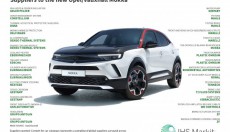
    Suppliers to the new Opel/Vauxhall Mokka
    The second-generation Opel/Vauxhall Mokka is assembled at the Stellantis Poissy facility in France. Output of this model, at the French plant, is expected to peak at more than 136,000 units in 2023, according to IHS Markit.
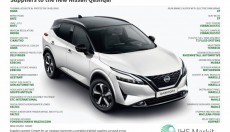
    Suppliers to the new Nissan Qashqai
    Produced by the Nissan since 2006, with most of the European volume built at Nissan’s Sunderland plant in the UK. Nissan’s compact crossover SUV is now in its third generation. With production starting in June 2021, the all-new Qashqai is Nissan's first model built in Europe using a significant number of lightweight aluminum panels, IHS Markit forecast production will reach its highest level of 303,000 units in 2023.
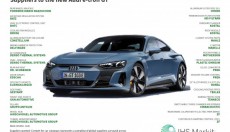
    Suppliers to the new 2022 Audi e-tron GT
    The first-generation Audi e-tron GT is assembled alongside the Audi R8 at Audi’s Boellinger Hoefe facility in Germany. Output of this model is expected to peak at 14,000 units in 2026, according to IHS Markit.
    Suppliers to the new 2022 BMW 2-Series
    The second-generation BMW 2-Series 2-door coupé (G42) is the first BMW designed by BMW of Mexico. It is also assembled in BMW's San Luis Potosi plant in Mexico. Output of this model is expected to peak at around 43,000 units in 2024, according to IHS Markit.
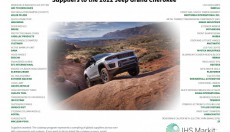
    Suppliers to the new 2022 Jeep Grand Cherokee
    The fifth-generation Jeep Grand Cherokee is assembled in Detroit Michigan, USA. Output of this model at the Michigan plants is expected to peak at around 480,000 units in 2023, according to IHS Markit.
    Chip shortage: Automakers’ plan to ensure supply of chips and guide their design
    Ford Motor took a step toward in addressing the chip shortage challenge in November, announcing a collaboration that will allow GlobalFoundries (GF) to increase supplies of semiconductors for Ford for its current vehicle lineup, as well as research and development (R&D) purposes. Ford already purchases chips from the company, but the new collaboration allows for more direct discussions, which could speed up manufacturing and purchasing. This is also an example of the OEMs working to avoid lo...
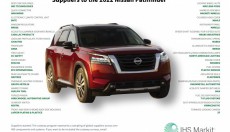
    Suppliers to the new 2022 Nissan Pathfinder
    The fifth-generation Nissan Pathfinder is assembled at the Nissan Smyrna Assembly Plant plant in Tennessee, USA. Output of this model at the Tennessee plant is expected to peak at around 115,000 units in 2024, according to IHS Markit. If you would like your company included in this feature or the car cutaways published in Automotive News or Automotive News Europe, please e-mail autotechinsight@ihsmarkit.com
    Suppliers to the new Rolls-Royce Ghost
    The second-generation Rolls-Royce Ghost is assembled at the Rolls-Royce plant in Goodwood, West Sussex, UK. Output of this model is expected to peak at more than 2,000 units in 2023, according to IHS Markit. If you would like your company included in this feature or the car cutaways published in Automotive News or Automotive News Europe, please e-mail autotechinsight@ihsmarkit.com
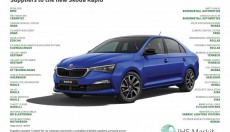
    Suppliers to the new Skoda Rapid
    The second-generation Skoda Rapid is assembled at the Volkswagen Group Kaluga facility in Russia. Output of this model at the Russian plant is expected to peak at more than 27,000 units in 2023, according to IHS Markit. If you would like your company included in this feature or the car cutaways published in Automotive News or Automotive News Europe, please e-mail autotechinsight@ihsmarkit.com.
    Electrification impact on Sensor Market
    For many years, growth in automotive sensors had been driven by improvements in safety, comfort, and propulsion efficiency, often spurred by local market regulations on emissions or key safety systems. While advanced driver assistance systems (ADAS) have led to new suites of sensors, such as radar, lidar, and cameras, the established sensors for measuring speed, current and position, or pressure and flow, are now being significantly affected by electrification, and especially in regards to ...
    How the upcoming ESC regulation will revolutionize the Indian driving assistance system market
    The importance of active safety systems in India came into focus in 2020 when consultancy Transport Research Laboratory (TRL) published a report that outlined the costs and benefits of electronic stability control (ESC) systems in G20 countries. While final dates have not been officially announced yet, the Indian government is expected to mandate fitment of ESC systems in all new cars in 2022. While the upcoming ESC regulation will be primarily aimed at improving safety, IHS Markit has identi...
    Automakers and suppliers to reinvent supply chain amid chip shortage
    Despite chip plants effectively running on full capacity, the global chip-shortage crisis may not be resolved next year, warned executives from German automotive companies during the IAA Mobility 2021 show in Munich. Top executives from several companies have publicly stated that they do not know when the chip shortage will be resolved. CEO of Daimler Ola Källenius said that “several chip suppliers have been referring to structural problems with demand … This could influence 2022 and [th...
    4D imaging radar: a reliable eye for autonomous vehicles
    The growing use of advanced driver assistance systems (ADAS) capabilities has been beneficial to the radar industry. It is a boon that will continue, not only because the market will grow, but also because of the rapid pace of innovation. The use of radar sensors for in-cabin sensing applications, such as driver and occupant monitoring, is expanding. According to IHS Markit June report, the global automotive radar market likely registered 124.4 million units in 2020. IHS Markit predicts that ...
    Qualcomm continues to advance in automotive sector
    Qualcomm, headquartered in California, is a semiconductor company best known for its efforts in smartphone connectivity through its popular Snapdragon brand of modems, application processors, and now radio frequency (RF). While smartphones are undoubtedly the company's bread and butter, Qualcomm also has a significant presence in a number of other industries. A great example of this is its USD10 billion (backlog) automotive business. While Qualcomm is a latecomer to the broader automotive ele...
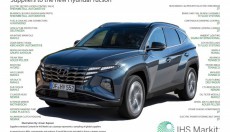
    Suppliers to the new Hyundai Tucson
    The fourth-generation 2021 Hyundai Tucson is assembled at Hyundai’s facility in Ostrava, Czech Republic. Output of the new version of the compact crossover SUV is expected to peak at more than 184,000 units in 2022, according to IHS Markit. If you would like your company included in this feature or the car cutaways published in Automotive News or Automotive News Europe, please e-mail Aman.kapoor@ihsmarkit.com.
    Special Report: Impact analysis of COVID-19 and the chip shortage crisis
    Compared to the previous light vehicle production forecast, almost 1.5 million fewer vehicles are forecast to be produced in 2021, which translates to a growth of 11.7% over 2020. Another 1 million more cars are now forecast to be produced in 2022 followed by a 700,000-unit increase in 2023. These vary regionally with North America seeing the biggest reduction in 2021 at about 1.1 million fewer cars produced, followed by Europe with a reduction of about 600,000 units. Greater China is forecast t...
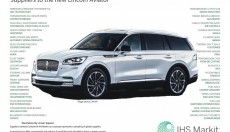
    Suppliers to the new Lincoln Aviator
    The second-generation Lincoln Aviator is assembled at Ford’s facility in Chicago SHO, United States. Output of the new mid-sized luxury SUV is expected to peak at more than 2,000 units in 2022, according to IHS Markit. If you would like your company included in this feature or the car cutaways published in Automotive News or Automotive News Europe, please e-mail Aman.kapoor@ihsmarkit.com.
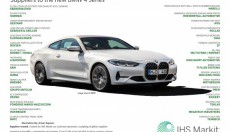
    Suppliers to the new BMW 4 Series
    The second-generation BMW 4 Series is assembled at BMW’s facility in Dingolfing, Germany. Output of the new version of the two-door coupe is expected to peak at more than 45,000 units in 2022, according to IHS Markit. If you would like your company included in this feature or the car cutaways published in Automotive News or Automotive News Europe, please e-mail Aman.kapoor@ihsmarkit.com.
    Geopolitics and the push for domestic semiconductor manufacturing
    The ongoing global semiconductor shortage is causing major problems for many industries worldwide. The shortage has been going on for a while, triggered first by the pandemic slowing production and exacerbated by a variety of factors ranging from changing market dynamics to geopolitical tensions. As shortages spread from automobiles to smartphones and displays, governments from Washington to Brussels and Beijing prioritized semiconductors. Major changes are taking place in the manufacturing s...
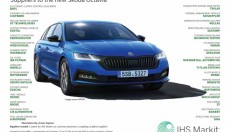
    Suppliers to the new Skoda Octavia
    The fourth-generation Skoda Octavia is assembled at the Volkswagen Group’s facility in Mlada Boleslav, Czech Republic, as well as Russia contract manufacturer GAZ’s plant in Nizhny Novgorod, Russia. Output of the new version of the five-door compact car is expected to peak at more than 233,000 units in Mlada Boleslav in 2022 and peak at 27,000 units in Nizhny Novgorod in 2022, according to IHS Markit. If you would like your company included in this feature or the car cutaways publishe...
    Gasoline particulate filters to remain in demand this decade owing to hybridization
    Carmakers all over the world are working numerous angles to make their vehicles as efficient as possible, owing to the prevalent eco-friendly sales strategy along with governments across the globe making environmental policies progressively more stringent every few years. A significant component of vehicular exhaust emissions is particulate matter (PM), which comprises microscopic particles that are so lightweight that they remain suspended in the air. Coarse particles, which measure 10 micromet...
    Suppliers to the new Mercedes-Benz CLA
    The second-generation 2019 Mercedes-Benz CLA is assembled at Daimler's facility in Kecskemet, Hungary. Output of the new version of the compact sedan is expected to peak at more than 98,000 units in 2022, according to IHS Markit. If you would like your company included in this feature or the car cutaways published in Automotive News or Automotive News Europe, please e-mail Aman.kapoor@ihsmarkit.com.
    Managing the chip shortage: Strategies ahead
    Semiconductor chips are critical components in new automobiles spanning from advanced infotainment systems to basic equipment such as power steering and brakes. Vehicles have thousands of semiconductors worth hundreds of US dollars, depending on the car and its options. Therefore, the semiconductor crisis that began in the first quarter of 2021 has brought assembly lines to a halt worldwide. The silicon chips have hampered the manufacturing of everything from smartphones to home appliances to...
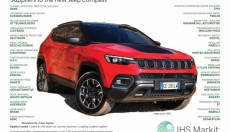
    Suppliers to the new Jeep Compass
    The second-generation 2021 Jeep Compass is assembled at Stellantis’ facility in Melfi, Italy. Output of the new version of the compact crossover SUV is expected to peak at more than 77,000 units in 2022, according to IHS Markit. If you would like your company included in this feature or the car cutaways published in Automotive News or Automotive News Europe, please e-mail Aman.kapoor@ihsmarkit.com.
    Global chip famine, now or forever?
    Ever since the pandemic hit last spring, there have been major inventory imbalances across the supply chain, specifically in the chip sector that has caused a global shortage of the component. It was a chain of events that started with the pandemic that forced people to operate from home, resulting in a sudden demand for consumer electronics going through the roof. This naturally caused chipmakers to adjust their supply to focus on these markets rather than the automotive market. How did t...
    Suppliers to the new Volkswagen T-Roc
    The first-generation 2020 Volkswagen T-Roc is assembled at Volkswagen’s facility in Osnabruck, Germany. Output of the new version of the subcompact crossover is expected to peak at more than 15,000 units in 2022, according to IHS Markit. If you would like your company included in this feature or the car cutaways published in Automotive News or Automotive News Europe, please e-mail Aman.kapoor@ihsmarkit.com.
    Suppliers to the new DS 3 Crossback
    The first-generation DS 3 Crossback is assembled at Stellantis’ factory in Poissy, France. Output of the new version of the small crossover is expected to peak at more than 24,000 units in 2023, according to IHS Markit. If you would like your company included in this feature or the car cutaways published in Automotive News or Automotive News Europe, please e-mail Aman.kapoor@ihsmarkit.com.
    Powertrain company spin-offs driven by global shift to electrification
    The past few years have already seen intense competition and innovation in the automotive powertrain sector magnifying several times over due to challenging market conditions, ever stricter regulatory and environmental policies, and the disruptions in the form of electrification and new players entering the markets across the globe. Powertrain components and systems manufacturers worldwide have responded by rapidly increasing the development of new or improved products, and consolidating their b...
    loading
    Searching our resources for you...
    preload preload preload preload preload preload